Antlia (Airpump)

Share one

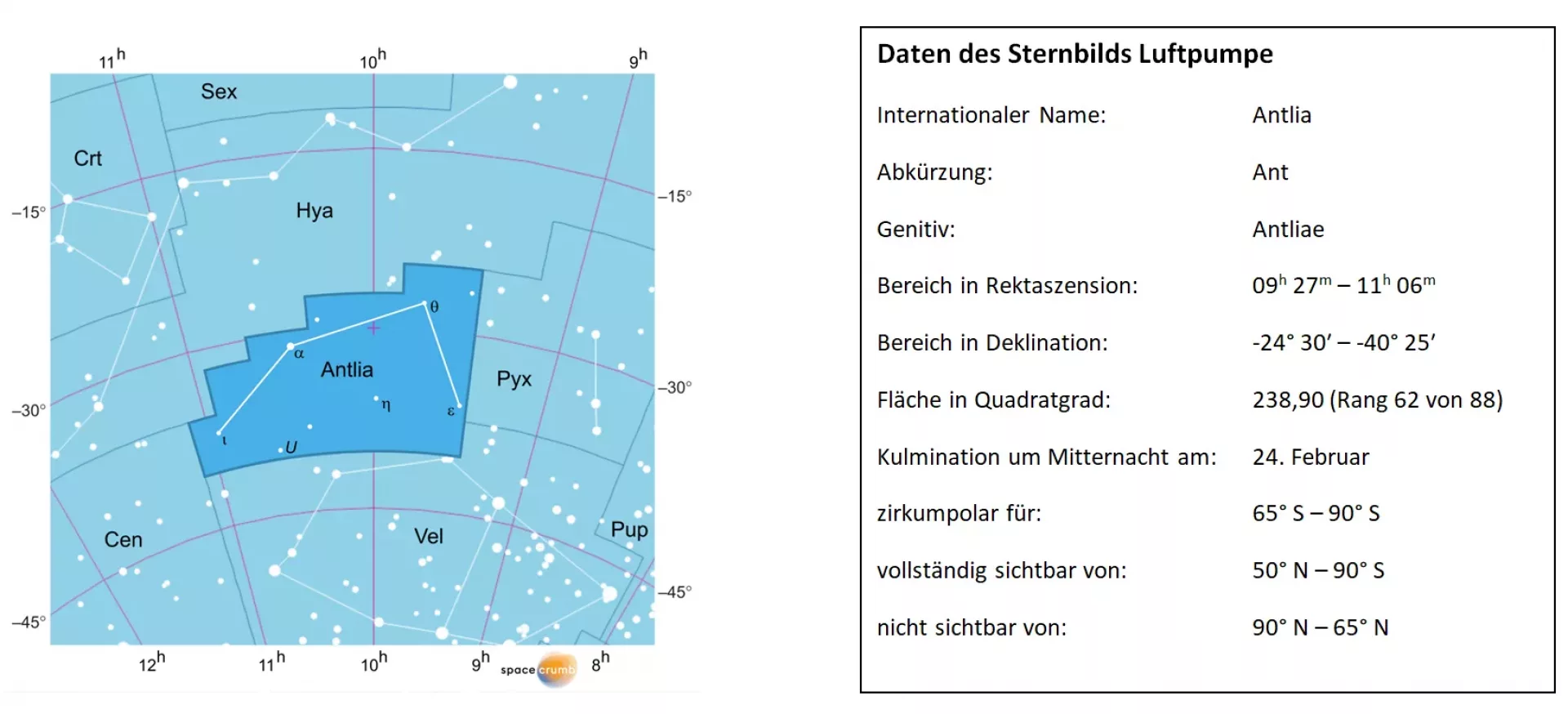
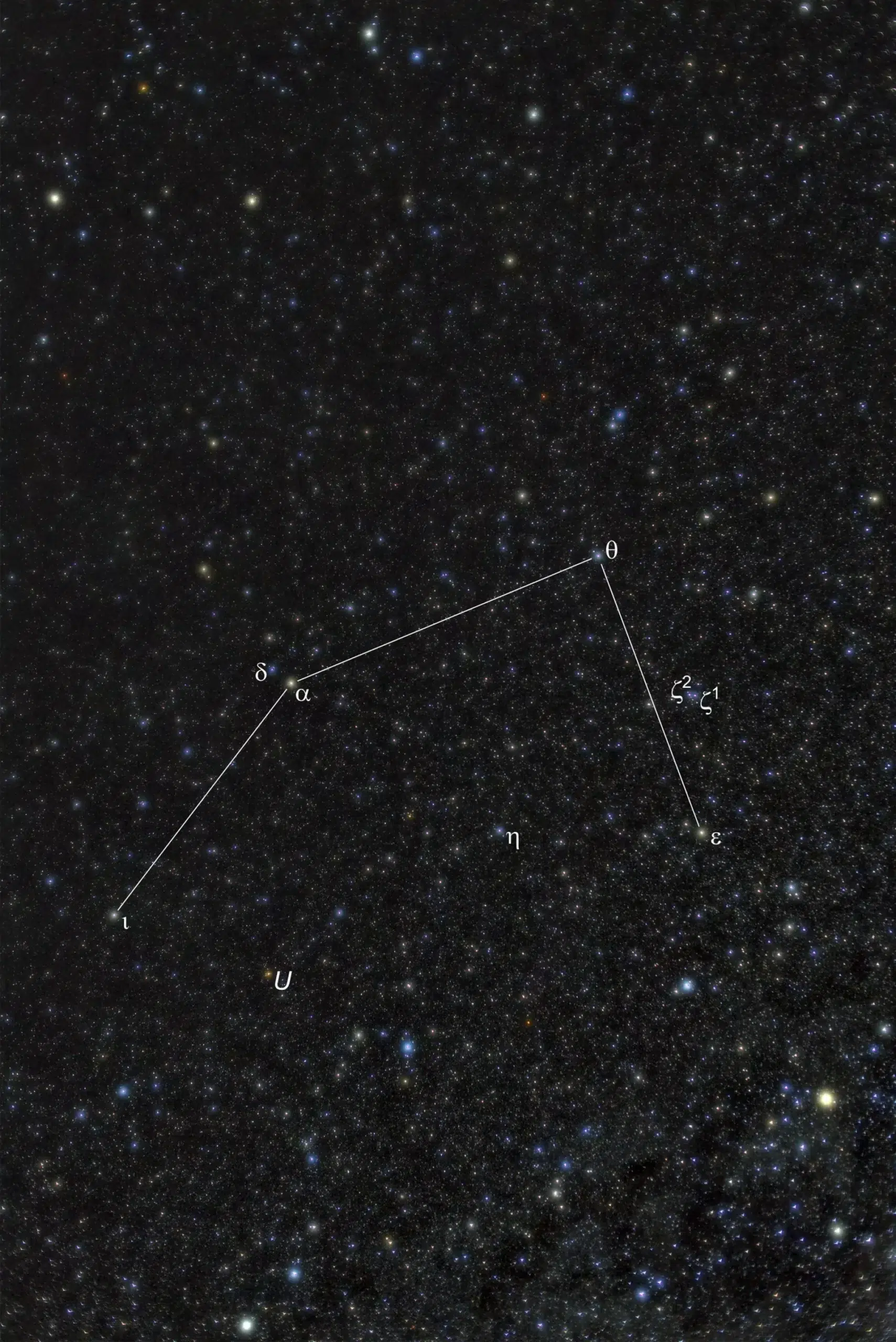
The Air Pump (Latin Antlia) is an inconspicuous constellation in the southern sky. Because it lies south of Hydra, it rises only just above the horizon when viewed from southern Europe. It is best seen in the evening sky from February to April, yet the light of its stars is usually absorbed by the haze near the horizon. Only south of the Tropic of Cancer does the constellation climb higher than 30° above the horizon around midnight. Its brightest star is Alpha Antliae (α Ant) with a magnitude of 4.25. Only three other stars exceed 5th magnitude. Neighboring constellations of Antlia—going clockwise from the north—are Hydra, Pyxis (the Compass), Vela (the Sails), and Centaurus.

Origin of the Constellation Antlia

Antlia is one of several curiosities among the 88 constellations of the night sky. It traces back to the French astronomer, surveyor, and mathematician Nicolas-Louis de Lacaille (1713–1762). After observing the southern sky from Cape Town, South Africa, between 1751 and 1753, Lacaille published a catalog of about 10,000 stars along with an accompanying star atlas. Because no ancient constellations had been passed down for the southern sky, Lacaille introduced fourteen new constellations of his own. For most of them, he chose the names of scientific and technical instruments. All of these constellations share the characteristic of being composed of faint stars and are relatively inconspicuous.

The Air Pump: A Groundbreaking Invention of the 17th Century

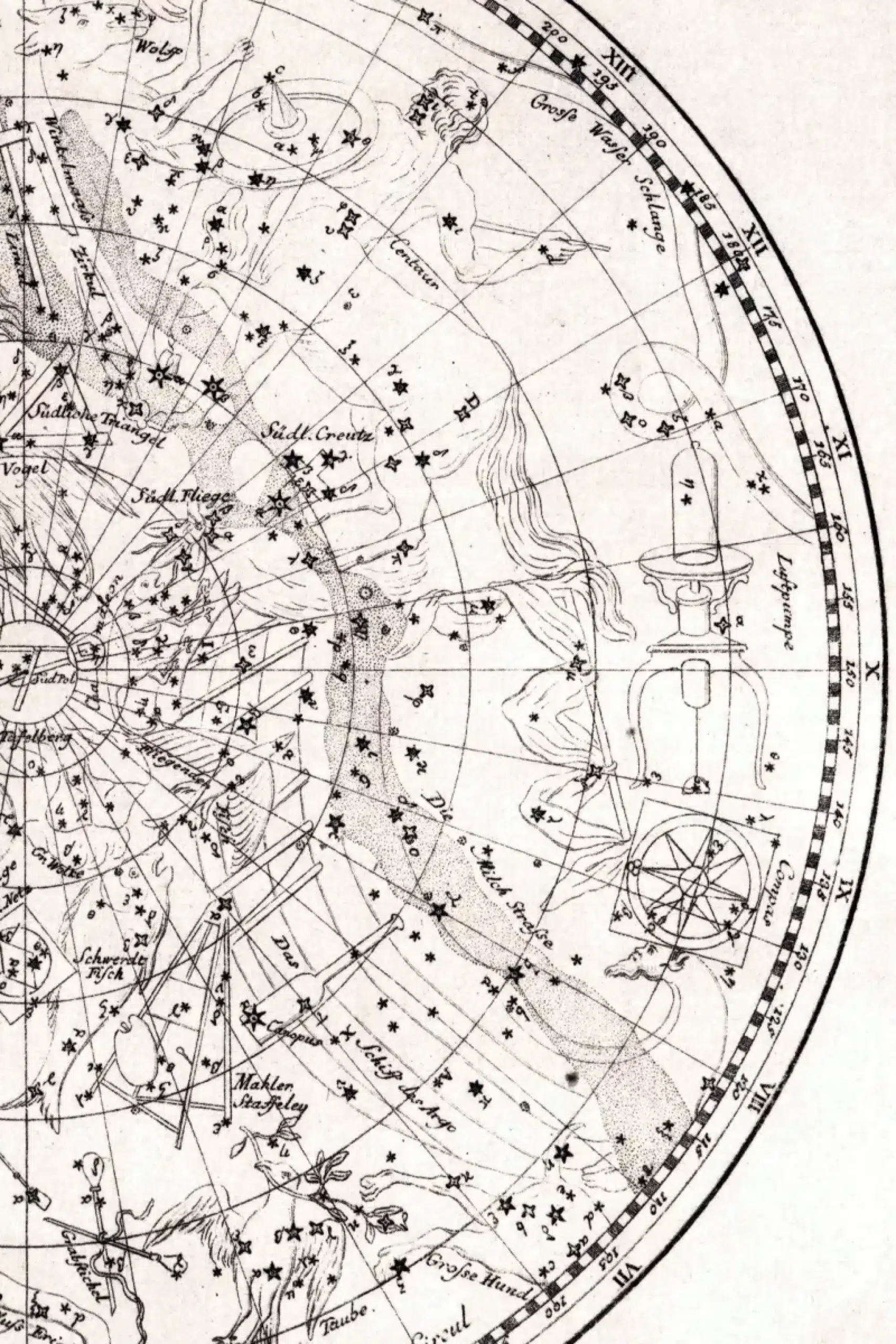
Nicolas-Louis de Lacaille placed the constellations he introduced—Antlia (the Air Pump) and Pyxis (the Compass, right)—between the historical constellations Centaurus, Hydra, and Argo Navis. (Source: Johann Elert Bode: Vorstellung der Gestirne auf XXXIV Tafeln, 1782)

As models for his new constellations, Lacaille—very much a child of the Enlightenment—selected what he considered to be the most important tools and instruments of technology, science, and art (originally: “les figures des principeaux instrumens des arts”). One such technical achievement was the air pump. Invented by Otto von Guericke (1602–1686), it allowed scientists to recognize the effects of air pressure and to advance the physics of gases. Lacaille’s depiction of the constellation closely resembles the “pneumatic machine” built by the Irish natural philosopher Robert Boyle (1627–1692) as an improved version of Guericke’s piston air pump.

Lacaille placed the constellation in an unobtrusive part of the sky between Hydra, Centaurus, the also newly introduced constellation Pyxis, and the formerly large constellation Argo Navis. He later divided the latter into the constellations Carina (the Keel), Puppis (the Stern), and Vela (the Sails). Under the Latin short form Antlia (originally Antlia Pneumatica), the constellation was included by the International Astronomical Union (IAU) in its official list of 88 constellations.

Related articles

Get in contact with us

If you are interested in Webservatory® we’d love to hear from you—get in touch for a demo or more information.