The Bird of Paradise (Latin Apus) is a constellation in the southern sky, located near the south celestial pole. It cannot be seen from Europe. Only at latitudes south of 7° N does the constellation rise fully above the horizon. Its brightest star is Alpha Apodis (α Aps) with an apparent magnitude of 3.80. Only slightly fainter is Gamma Apodis (γ Aps) at 3.85 mag. All other stars in this constellation belong to the 4th magnitude or fainter, making Apus a very inconspicuous constellation.
Its neighboring constellations—starting from the north and moving clockwise—are Triangulum Australe (the Southern Triangle), Circinus (the Compasses), Musca (the Fly), Chamaeleon, Octans, Pavo (the Peacock), and Ara (the Altar).
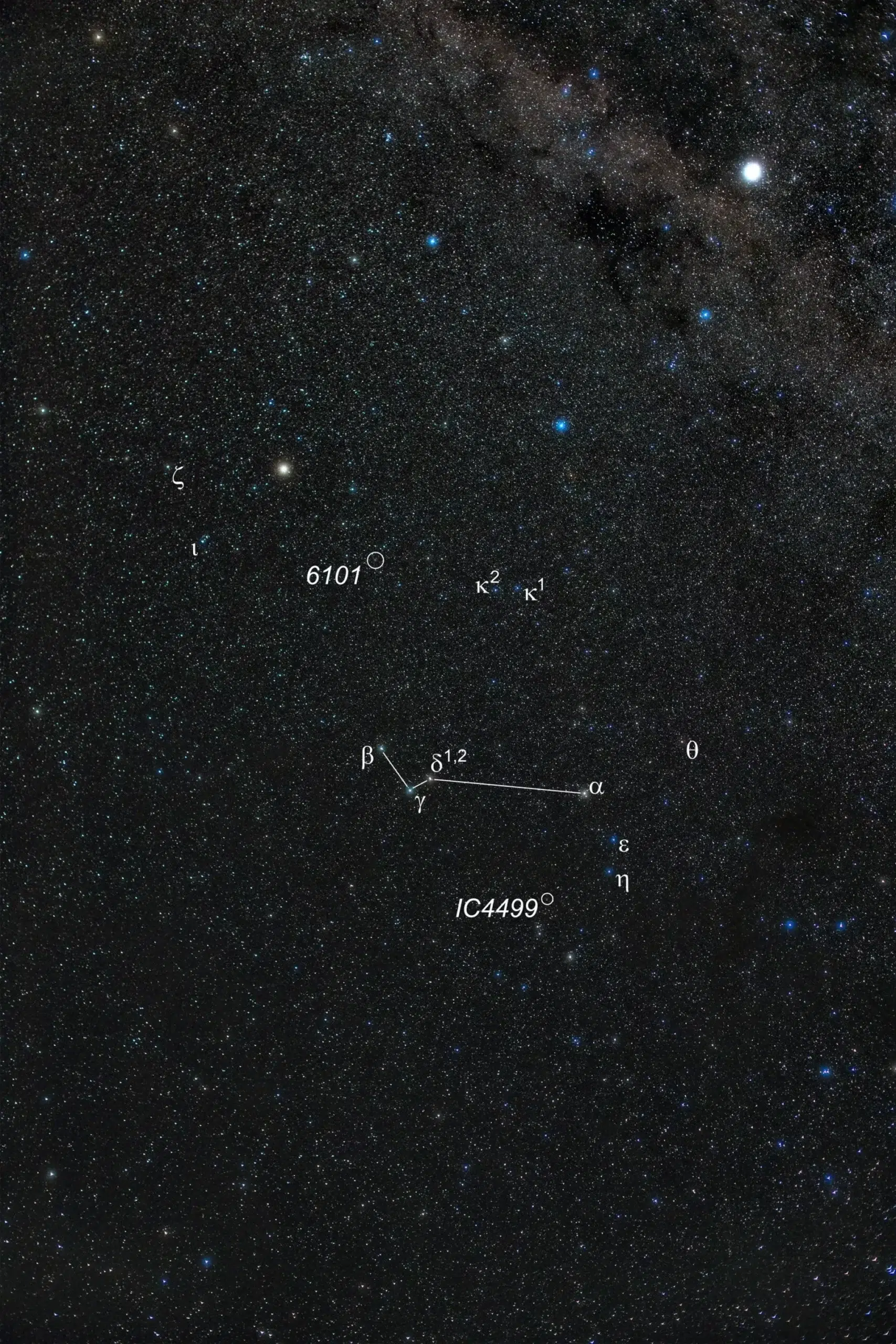
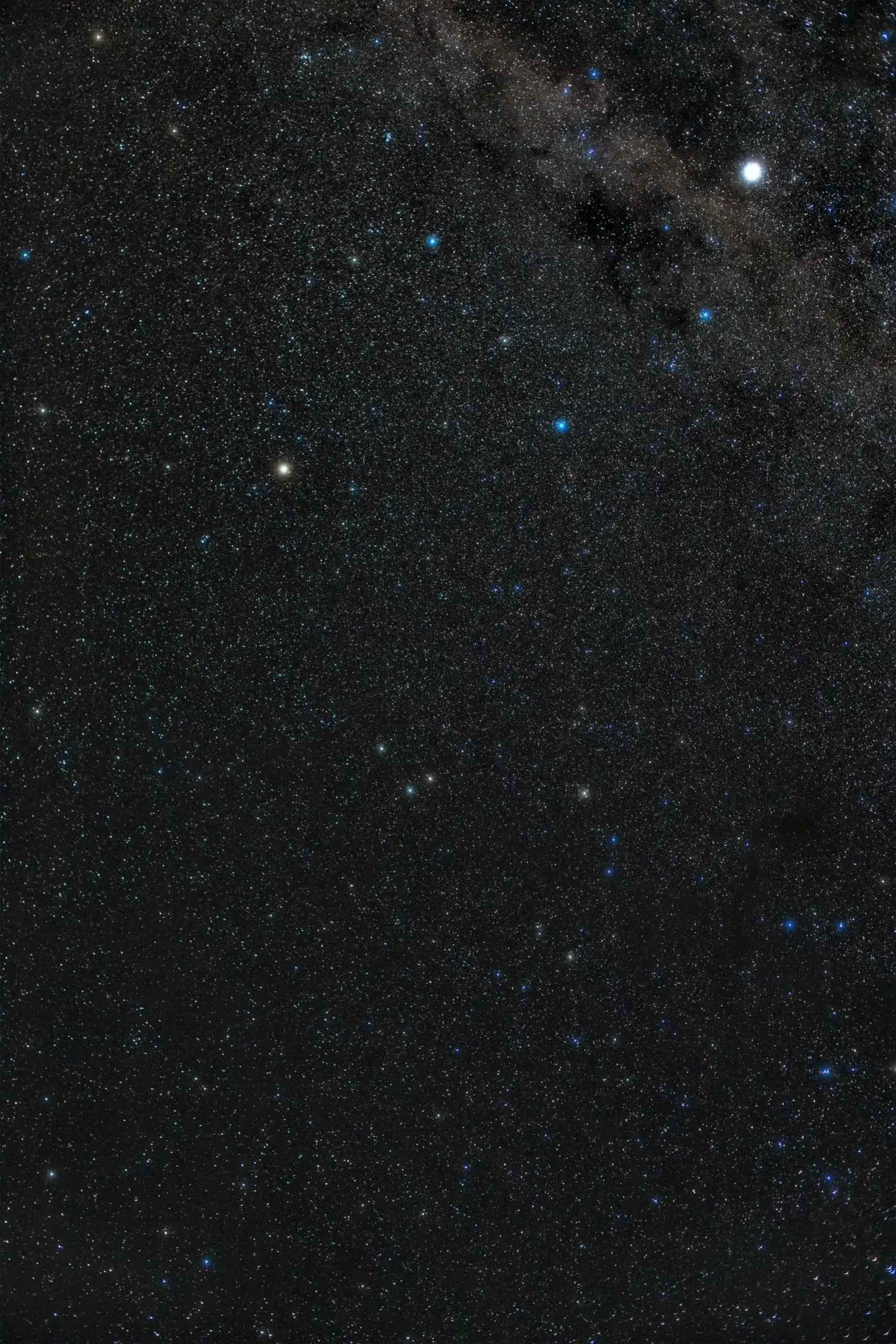
Fig. 2a,b: The constellation Apus lies between the bright star Alpha Centauri (top of the image) and the south celestial pole (bottom of the image). (Images: Uwe Reichert)
The Globular Cluster NGC 6101
In the northern part of the constellation Apus lies the small globular cluster NGC 6101, with an apparent brightness of about 9th magnitude. Its compact central region has an apparent diameter of three arcminutes. Long-exposure photographs reveal its loose outer regions, which extend over an angular diameter of about nine arcminutes. Visually, a telescope with at least 20 cm aperture is required to resolve individual stars.
The globular cluster is located roughly 47,000 light-years from Earth and about 34,000 light-years from the center of our Milky Way. NGC 6101 is one of the few metal-poor globular clusters that orbit the Galactic Center on a retrogradetrajectory. It takes approximately 500 million years to complete one such orbit.
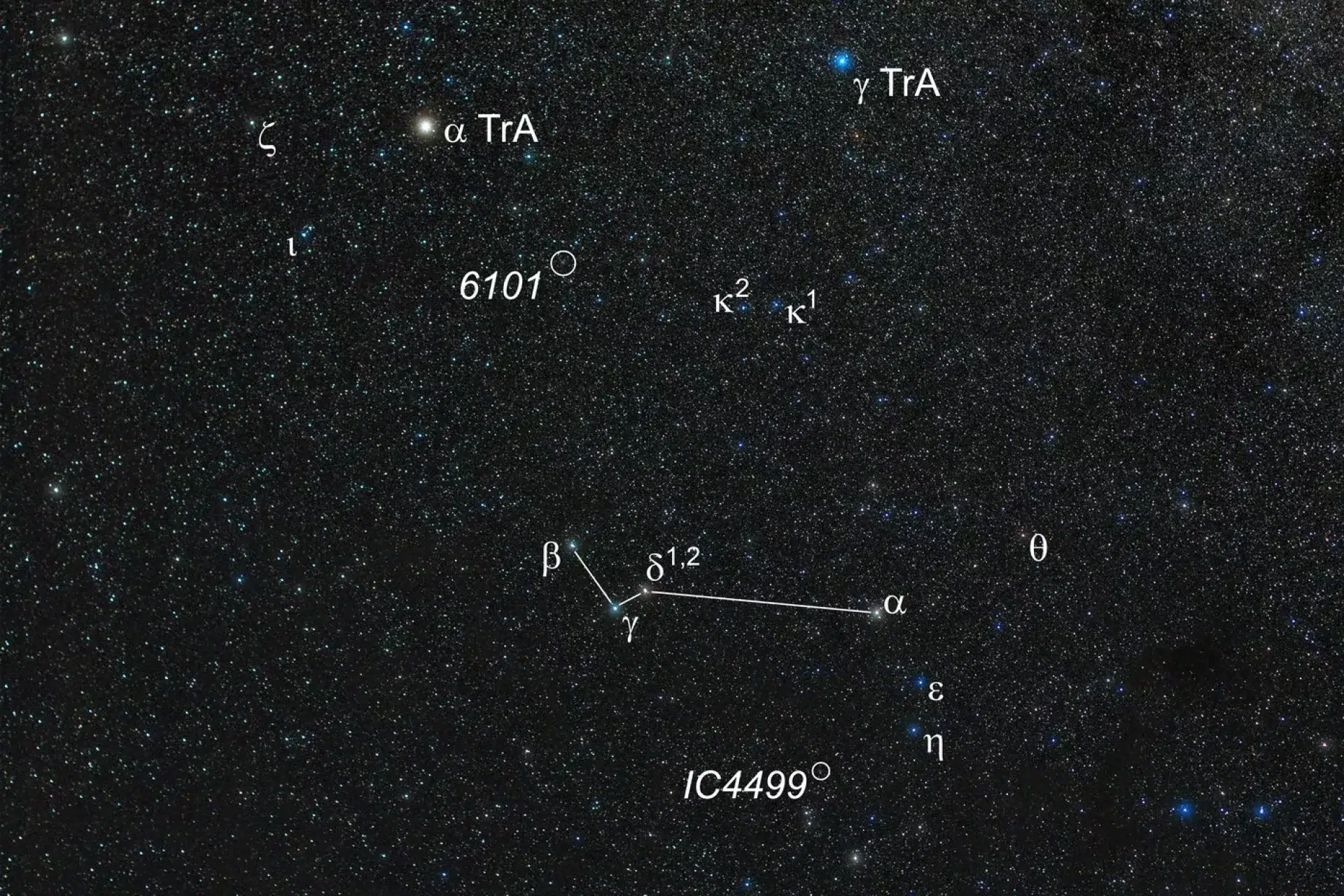
The brightest star in the vicinity is Alpha Trianguli Australis (α TrA), located 3.7° northeast of NGC 6101 with a magnitude of 1.9. The cluster lies roughly halfway along the line connecting Iota Apodis and the stellar pair Kappa-1 and Kappa-2 Apodis. Due to its southern location, there are only a few photographs of NGC 6101 available. Noteworthy examples can be found on the websites of David Oesper and Fabian Rodriguez.
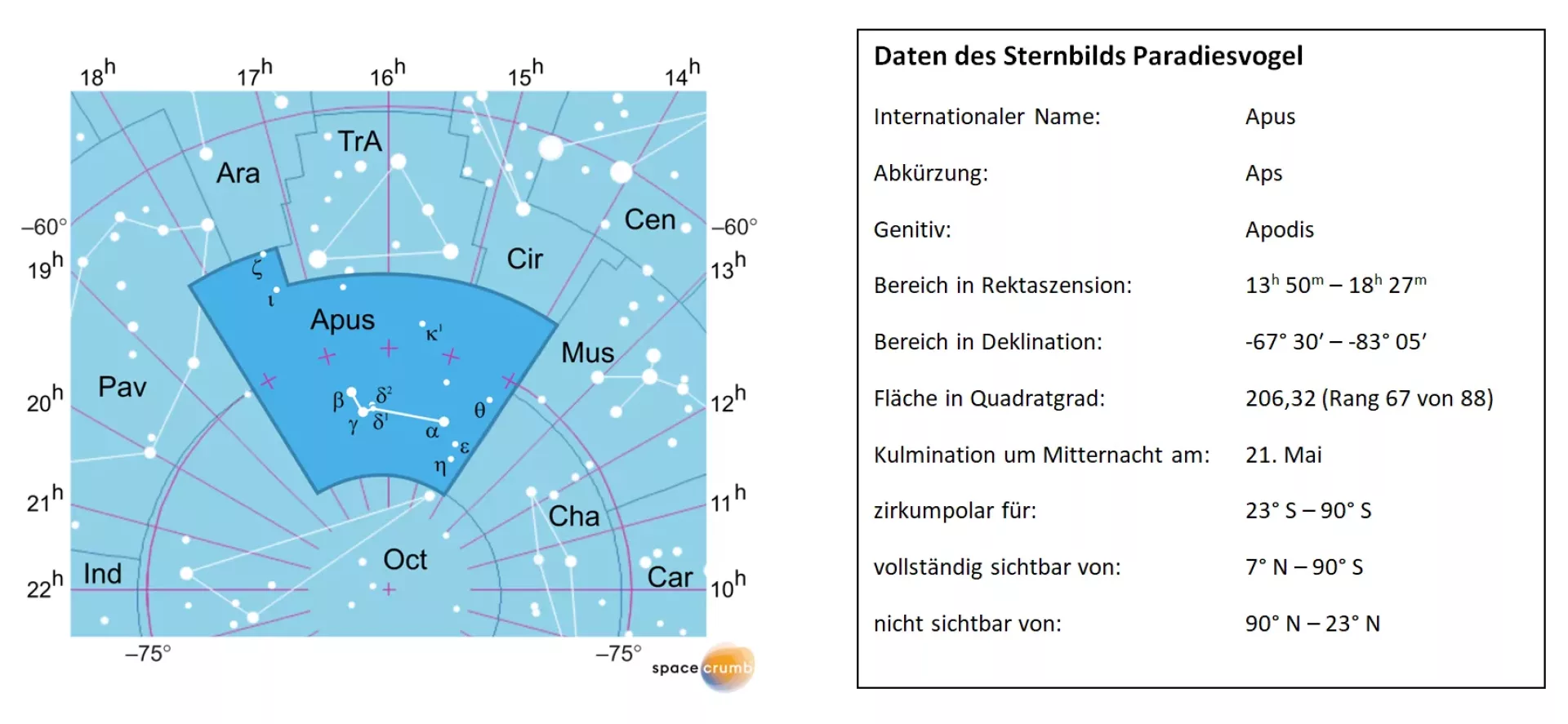
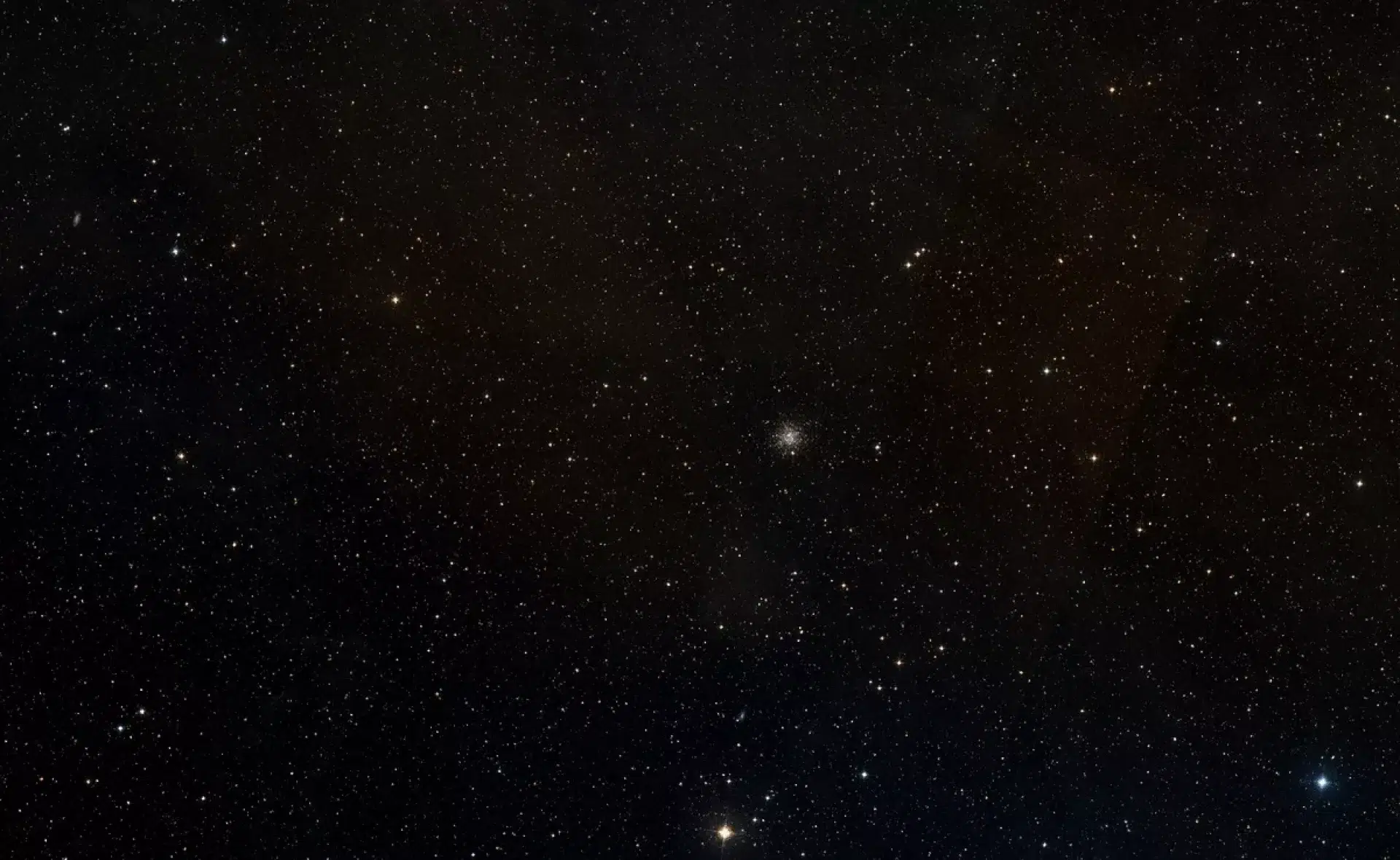
Fig. 3a: The field around the globular clusters NGC 6101 and IC 4499 in the constellation Apus. (Image: Uwe Reichert)
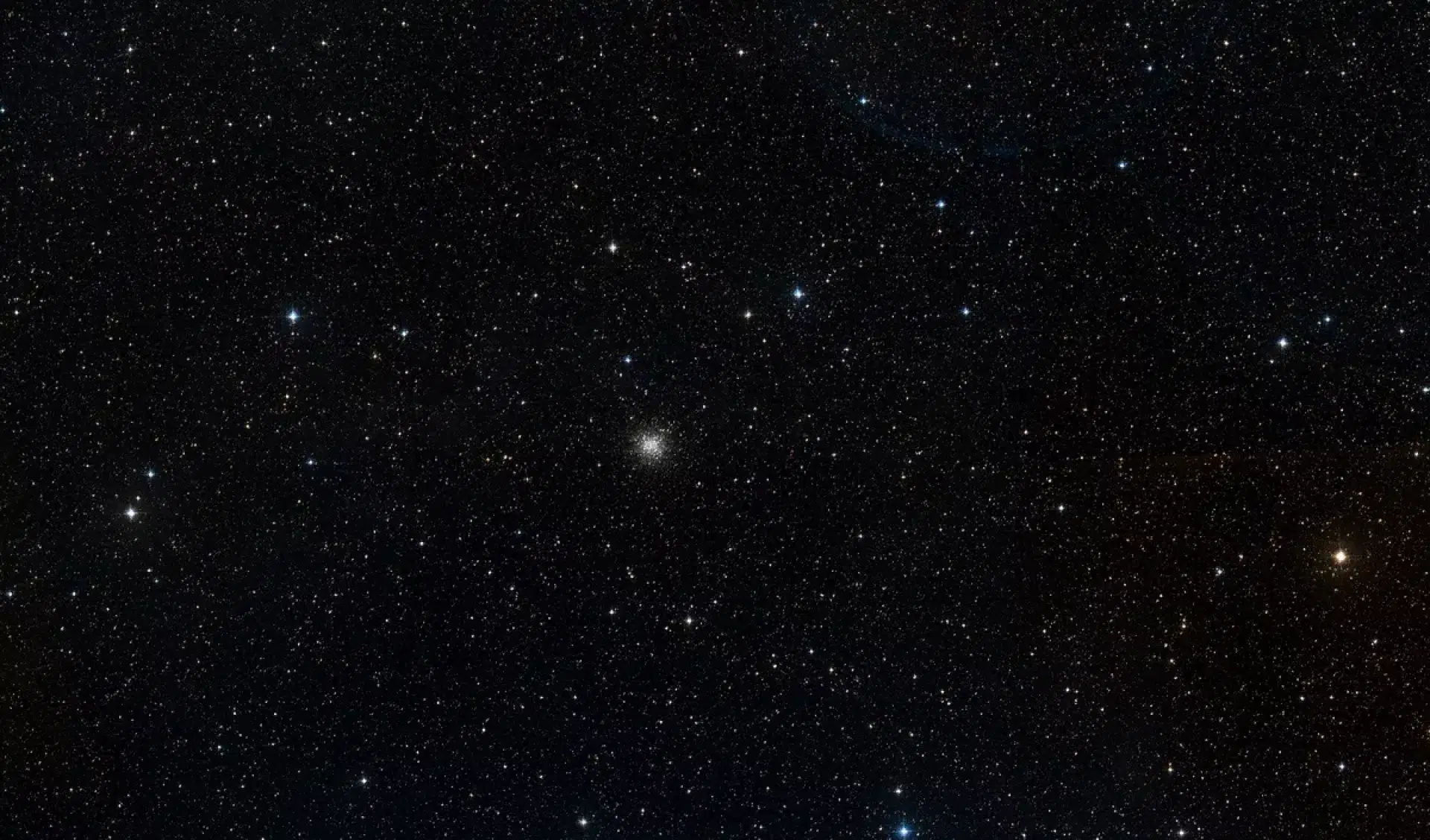
Fig. 3b: Only at high magnification can the globular cluster NGC 6101 be recognized as a non-stellar object. An interactive version of this image of NGC 6101 is available in the Aladin Sky Atlas of the CDS, Strasbourg Observatory, France. (Image: Digitized Sky Survey – STScI/NASA, colored & HEALPix-processed by CDS)
IC 4499 – The Southernmost of All Galactic Globular Clusters
While NGC 6101 is located in the northern part of the constellation Apus, the slightly fainter globular cluster IC 4499 lies in the southern part, near the border with the constellation Octans. With a declination of –82°, IC 4499 is also the southernmost of all galactic globular clusters. There is indeed another globular cluster situated even farther south, NGC 1841 at –84° declination, but it does not belong to our Milky Way. Instead, it is dynamically associated with the Magellanic Clouds, two satellite galaxies of our own.
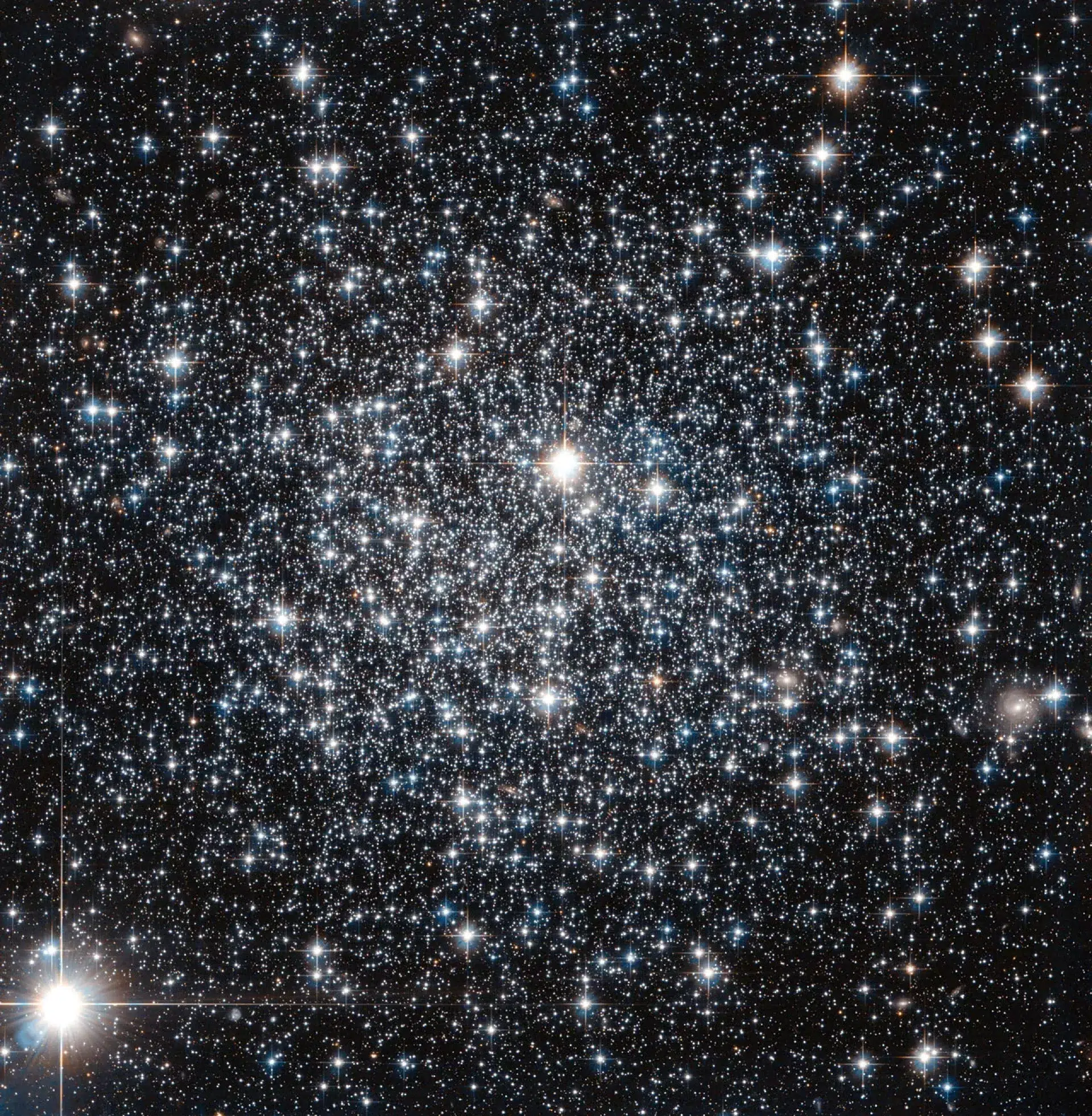
The compact central region of IC 4499 has an angular diameter of only about two arcminutes. Farther out, the star cluster becomes noticeably looser, but its members are distributed within a circle about ten arcminutes across. IC 4499 is located roughly 60,000 light-years from Earth and about 50,000 light-years from the Galactic Center. The cluster is 12 billion years old and contains a mass of about 150,000 solar masses, half of which is concentrated within a diameter of 50 light-years. Its mass places IC 4499 in the intermediate range for globular clusters, making it an interesting object for studying the formation history of these very old stellar systems.
In recent years, it has become increasingly evident that more massive globular clusters typically host multiple stellar populations, indicating that their stars did not all form at the same time, but instead over an extended period across multiple generations. Low-mass globular clusters, however, contain only a single stellar population, meaning all their stars are the same age. IC 4499 lies in a transitional mass range, and—like the smaller clusters—shows only a single stellar population.
Fig. 4a: High-resolution images of IC 4499 can also be obtained with the Hubble Space Telescope. North in this image is located at about the 2 o’clock position. (Image: ESA/Hubble & NASA)
Fig. 4b: Slightly fainter than NGC 6101, the globular cluster IC 4499 lies in the constellation Apus. An interactive version of this image of IC 4499 is available in the Aladin Sky Atlas of the CDS, Strasbourg Observatory, France. (Image: Digitized Sky Survey – STScI/NASA, colored & HEALPix-processed by CDS)
Origin of the Constellation Apus
The constellation Apus is one of twelve southern constellations that trace their origins to the observations of the Dutch navigators Pieter Dirkszoon Keyser (1540–1596) and Frederick de Houtman (1571–1621). On a voyage to the East Indies, they measured the positions of stars in the southern sky on behalf of their compatriot, the cartographer Petrus Plancius (1552–1622). Their original records have unfortunately not survived; only the catalog compiled by de Houtman during his second sea voyage—printed in the appendix of his Malay dictionary published in 1603—has been preserved.
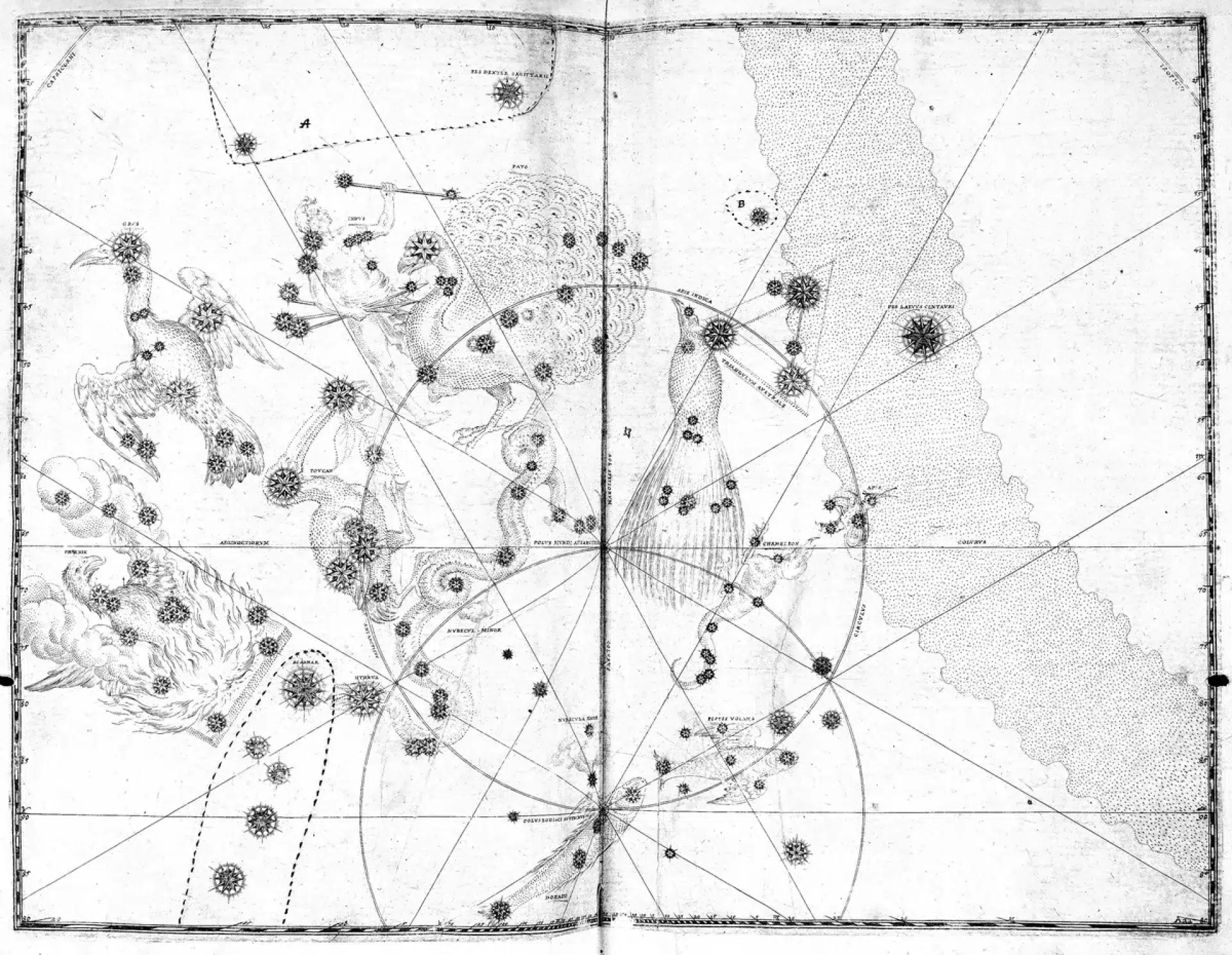
Keyser and Houtman had named the constellation “De Paradijs Voghel” (“The Bird of Paradise”). The Flemish cartographer Jodocus Hondius (1563–1612) adopted the bird—said to be footless—under the Latinized name “Avis Paradisi” on a globe he produced in 1601. Johann Bayer (1572–1625), who devoted a map to the twelve new southern constellations in his 1603 Uranometria, called it “Apis Indica”, the “Indian Bird,” although this was due to a spelling mistake (apis meaning “bee” in Latin, whereas avis means “bird”).
The constellation was eventually included as “Apus” by the International Astronomical Union (IAU) in its list of 88 official constellations. The name derives from the Greek apous, meaning “footless.”